
Online Family Mediation for Parents Living in Different States: A Better Way to Resolve Family Disputes
When Distance Creates Conflict, Mediation Creates Solutions
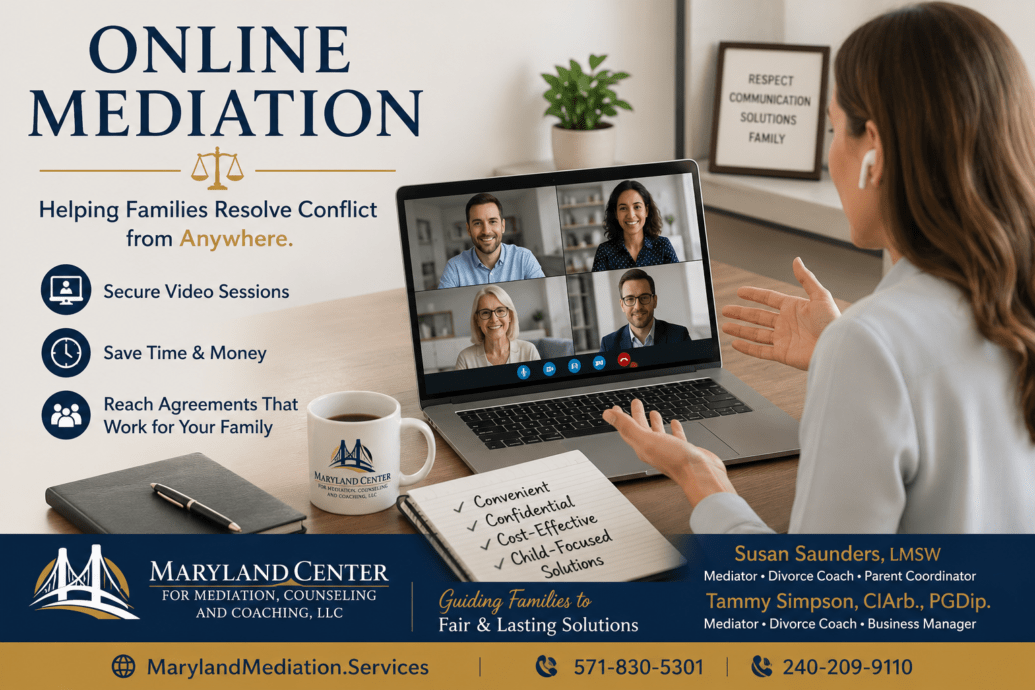
Families today are more geographically separated than ever before. Parents relocate for work, military service, education, remarriage, or family support. As a result, many child custody, parenting plan, divorce, and family disputes involve people living in different states, making Online Family Mediation for Parents a better way to resolve family disputes.
Although distance can complicate legal matters, it does not have to make conflict resolution more difficult.
At the Maryland Center for Mediation, Counseling and Coaching, LLC, we help families resolve disputes through online family mediation and virtual divorce mediation, allowing participants to reach agreements without expensive travel or lengthy court proceedings. Whether one parent lives in Maryland and the other lives in Florida—or anywhere else in the United States—our experienced mediators provide practical, confidential, and child-focused solutions.
Susan Saunders, LMSW, is an experienced mediator, divorce coach, and Parenting Coordinator who has helped families navigate difficult transitions with professionalism and compassion. Together with Tammy Simpson, Florida Supreme Court Certified Family Mediator, our team provides mediation services for clients throughout Maryland, Florida, and beyond.
What Is Online Family Mediation?
Online family mediation is a structured process that allows people to participate in mediation sessions using secure video conferencing instead of meeting in person.
The mediation process remains the same. The only difference is the location.
Instead of traveling to an office or courthouse, participants meet from their homes, offices, or any private location with internet access.
Online mediation is particularly effective when parents or spouses live in different states because it eliminates travel while allowing everyone to participate equally.
Who Can Benefit from Interstate Mediation?
Online mediation works well for families experiencing:
- Divorce
- Child custody disputes
- Parenting plan modifications
- Child support disagreements
- Relocation cases
- Grandparent visitation disputes
- Property division
- Military family relocations
- High-conflict co-parenting
- Blended family disagreements
Many of our clients live hundreds—or even thousands—of miles apart. Despite the distance, they successfully negotiate comprehensive agreements through virtual mediation.
Why More Families Choose Online Mediation
Traditional litigation often requires repeated court appearances, attorney meetings, and significant travel expenses.
Online mediation offers several advantages.
Save Thousands of Dollars
Mediation typically costs far less than litigation because it reduces attorney fees, court costs, and travel expenses.
Resolve Matters Faster
Court schedules often delay hearings for months. Mediation allows families to begin working toward solutions much sooner.
Participate from Anywhere
Parents can join from different cities, states, or even countries without disrupting work or family schedules.
Reduce Conflict
Rather than encouraging confrontation, mediation promotes respectful communication and collaborative problem-solving.
Protect Children
Children benefit when parents work together to create practical parenting plans instead of engaging in prolonged legal disputes.
Common Interstate Family Issues
Families living in different states frequently need help resolving questions such as:
Parenting Time
How will holidays, birthdays, and school breaks be shared?
Transportation
Who pays travel costs?
Where will exchanges occur?
How will flights be coordinated?
Virtual Communication
How often should children have video calls with the other parent?
What technology will be used?
School Decisions
Which parent makes educational decisions?
How will report cards and school records be shared?
Medical Care
How will parents communicate about healthcare, therapy, or emergencies?
Mediation allows families to answer these questions before they become future conflicts.
Understanding Interstate Custody Laws
When parents live in different states, custody decisions often involve the Uniform Child Custody Jurisdiction and Enforcement Act (UCCJEA). This law helps determine which state’s courts have authority to make or modify custody orders.
Although mediation does not replace legal advice, it helps parents reach practical agreements that can later be incorporated into court orders when appropriate.
How the Online Mediation Process Works
Our online mediation process is simple and convenient.
Step 1: Schedule a Consultation
We begin with an initial consultation to understand your family’s needs and explain the mediation process.
Step 2: Gather Information
Both parties provide relevant financial information, parenting concerns, and any existing court orders or agreements.
Step 3: Attend Virtual Mediation Sessions
Using a secure video platform, the mediator facilitates productive discussions while helping everyone stay focused on solutions.
Step 4: Draft the Agreement
Once agreements are reached, we prepare detailed written documents reflecting the decisions made during mediation.
Step 5: Filing Assistance
When appropriate, we help clients understand the filing process so agreements can be submitted to the court.
Why Families Choose Susan Saunders
Families trust Susan Saunders because she combines legal process knowledge with decades of experience helping people resolve conflict.
Clients appreciate her:
- Calm communication style
- Child-focused approach
- Extensive mediation experience
- Practical problem-solving
- Ability to reduce conflict
- Compassion during emotionally difficult situations
Whether parents live 20 miles apart or 2,000 miles apart, Susan helps them create lasting agreements that work for their families.
Why Choose the Maryland Center for Mediation, Counseling and Coaching, LLC?
Our team provides:
- Online Divorce Mediation
- Child Custody Mediation
- Parenting Plan Development
- Interstate Parenting Agreements
- Child Support Mediation
- Property Division Mediation
- Divorce Coaching
- Parent Coaching
- Parenting Coordination
- High-Conflict Family Mediation
We proudly serve clients throughout Maryland, Florida, and across the United States through secure online mediation.
Frequently Asked Questions
Can mediation be completed if we live in different states?
Yes. Online mediation allows both parties to participate from separate locations without traveling.
Is online mediation legally recognized?
In many situations, yes. Agreements reached through mediation can often be incorporated into court orders, subject to the laws of the applicable jurisdiction.
Do we have to be in Maryland?
No. We frequently work with families where one parent lives in Maryland and the other resides in another state, including Florida.
Is online mediation confidential?
Yes. Mediation sessions are confidential except where disclosure is required by law or agreed upon by the participants.
Can mediation help if we already have a court order?
Yes. Mediation is commonly used to modify parenting plans, visitation schedules, and other family agreements.
Resolve Family Disputes Without Crossing State Lines
Distance should never prevent families from finding peaceful solutions. Through secure online mediation, the Maryland Center for Mediation, Counseling and Coaching, LLC helps parents and spouses resolve disputes efficiently, respectfully, and affordably.
If you or your co-parent live in different states, we are here to help.
Schedule your consultation today with Susan Saunders.
What is Cross-State Mediation?
Cross-state mediation refers to the process of resolving family disputes where the parties involved live in different states. This form of mediation allows individuals to come together with the help of a neutral mediator, regardless of their geographical location. Cross-state mediation is often used in cases of divorce, child custody, visitation, co-parenting, and other family law issues where the parties are not in the same jurisdiction.
Unlike litigation, which involves formal legal proceedings in a courtroom and requires both parties to appear in person, cross-state mediation can be conducted remotely. This flexibility allows families to resolve their disputes without the need for travel, reducing both time and costs.
The Process of Cross-State Mediation
1. Initial Consultation
The process typically begins with an initial consultation between the mediator and the parties involved. During this consultation, the mediator gathers information about the dispute, discusses the parties’ goals, and explains the mediation process. For cross-state cases, this can be done via phone or video conferencing, making it convenient for all parties to participate.
2. Scheduling Mediation Sessions
Once both parties agree to mediate, the mediator schedules a series of sessions to address the various issues at hand. These sessions can be conducted remotely, eliminating the need for travel and allowing for greater flexibility in scheduling. The mediator’s role is to ensure that both parties are heard and that the discussions remain respectful and productive.
3. Negotiation and Agreement
Throughout the mediation sessions, the mediator helps the parties identify the key issues in dispute, explore potential solutions, and negotiate terms that are acceptable to both sides. The goal is to reach a resolution that is fair and sustainable, keeping the best interests of all parties involved in mind.
In cross-state cases, mediators can help families navigate complex issues such as child custody arrangements, visitation schedules, and asset division, even when the parties are living in different states. The mediator works to bridge the distance by facilitating communication and understanding between the parties, helping them reach agreements that are feasible and realistic.
4. Finalizing the Agreement
Once a resolution is reached, the mediator helps both parties draft a written agreement that outlines the terms of the settlement. In some cases, the mediator may recommend that the agreement be submitted to the court for formal approval. This ensures that the agreement is legally binding and enforceable.
Advantages of Cross-State Mediation
1. Cost-Effective and Time-Saving
One of the most significant benefits of cross-state mediation is its cost-effectiveness. Traditional litigation can be expensive, with costs associated with court fees, attorney fees, travel, and other related expenses. In contrast, mediation is typically much more affordable, as it involves fewer formal proceedings and can be conducted remotely.
Cross-state mediation eliminates the need for travel between states, saving both time and money for all parties involved. It allows families to resolve their disputes more quickly, without the delays and expenses associated with long-distance court appearances.
2. Flexibility and Convenience
Cross-state mediation is incredibly flexible, allowing families to resolve their disputes on their own terms. Since mediation can be conducted remotely via video conference or phone, participants don’t need to worry about scheduling flights or taking time off work to attend court hearings. This convenience makes mediation an attractive option for families with members in different states who may otherwise find it difficult to attend in-person proceedings.
Additionally, mediation allows for flexible scheduling. The parties involved can coordinate with the mediator to find a time that works for everyone, making it easier to work around their busy schedules.
3. Reduced Emotional Strain
Family disputes, especially those involving divorce or child custody, can be emotionally taxing. Court battles can exacerbate these emotions, leading to increased stress, anger, and resentment between the parties. Mediation, on the other hand, fosters a cooperative and less adversarial environment.
Mediators are trained to facilitate discussions in a way that encourages understanding and empathy, which can help reduce the emotional strain often associated with family disputes. Cross-state mediation offers an opportunity for families to work through their issues with the help of a neutral third party, without the added tension of courtroom conflict.
4. Confidentiality and Privacy
Mediation is a private and confidential process, which is especially important for families dealing with sensitive issues. Unlike court proceedings, which are public and subject to disclosure, mediation allows families to keep their discussions and agreements private. This confidentiality provides a safe space for families to express their concerns and work toward resolution without fear of public scrutiny.
5. Customizable Solutions
One of the key advantages of mediation is that it allows families to craft their own solutions. Unlike a court trial, where a judge imposes a decision based on the law, mediation allows both parties to negotiate and come to a mutually acceptable agreement. This flexibility is especially valuable in cross-state cases, where families can tailor their agreements to accommodate their unique circumstances and needs.
For example, in a cross-state child custody case, parents can work together to create a visitation schedule that works for both parties, taking into account the logistics of travel and the children’s needs. Mediation empowers families to make decisions that are in the best interest of their children, rather than having a judge impose a one-size-fits-all solution.
6. Enforceable Agreements
In cross-state mediation, the agreements reached are legally binding. Once both parties have agreed to the terms of the settlement, the mediator helps draft a formal agreement that can be submitted to the court for approval. Once approved, the agreement is enforceable, ensuring that both parties adhere to the terms of the settlement.
Why Choose Maryland Mediation Services?
At Maryland Mediation Services, we specialize in cross-state mediation, bridging the gap between families in Maryland and Florida. Led by Susan Saunders, LMSW, and Don Saunders, Certified Mediator, we offer a compassionate, neutral approach to resolving family disputes, no matter where the parties reside.
Susan Saunders is an accredited mediator in both Maryland and Florida and has over 20 years of experience helping families navigate difficult conflicts, including those that cross state lines. As a Certified Trauma Specialist and Parenting Coordinator, Susan brings a unique understanding of the emotional complexities of family disputes, ensuring that every family receives the support they need.
Don Saunders, a certified mediator with extensive experience in family law mediation, works alongside Susan to offer practical, effective solutions for families in Maryland and Florida. Together, they provide expert mediation services that help families move forward with confidence and peace of mind.
If you are facing a family dispute that spans across Maryland and Florida, Maryland Mediation Services can help. We offer flexible, cost-effective mediation options that allow families to resolve their issues efficiently and compassionately.
Contact Maryland Mediation Services today to schedule your free 30-minute consultation. Reach out to Susan at susan@marylandmediation.services and take the first step toward resolving your family dispute with professionalism and care.
Conclusion
Cross-state mediation is an invaluable tool for families seeking resolution to disputes that involve members in different states. By offering a flexible, cost-effective, and confidential alternative to traditional litigation, cross-state mediation allows families to address their issues in a way that prioritizes cooperation and long-term resolution. Maryland Mediation Services, led by Susan and Don Saunders, is here to help families across Maryland and Florida navigate disputes with compassion, care, and expertise.

No comment